

How to Adopt Skills-Based Hiring
A CV describes a career path, but it does not always demonstrate the ability to succeed in a role. Skills-based hiring means assessing what a person can do against criteria linked to the actual work. For recruiters, the aim is practical: to open the door to relevant candidates without lowering standards.
This approach does not require removing all degree requirements or multiplying tests. Above all, it involves defining essential skills, gathering comparable evidence and making decisions using a shared method. Here is how to put it into practice, from analysing the hiring need to following up after the hire.
Change the starting point: the work before the career path
In a CV-centred selection process, degrees, job titles and years of experience often serve as initial filters. They indicate exposure to certain situations, but remain indirect indicators of proficiency.
A skills-based approach starts differently: what tasks will the person need to perform? Under what conditions? With what level of autonomy? The answers become the assessment criteria.
For example, when hiring for a customer service role, “three years of experience in our sector” could give way to “handle a routine complaint, explain a solution and identify situations that need to be escalated to a manager”. A career changer can then demonstrate transferable skills.
Regulatory requirements still apply. When a degree, certification or authorisation is mandatory to practise, that requirement does not disappear. The aim is to remove unjustified filters, not necessary qualifications.
Implement skills-based hiring in six steps
To begin, choose a role with reasonably stable responsibilities and bring the recruiter and the future line manager together. One well-documented hire will be more useful than an immediate overhaul of all your practices.
1. Describe the expected outcomes in the role
Before writing the job advert, ask the manager what the person will need to achieve during their first few months. Avoid answers such as “be proactive” or “have good interpersonal skills”: they do not say what you will need to observe.
Turn these into specific situations. For an administrative role, this might mean checking an incomplete file, following up with a contact and meeting a deadline. For a sales role, it might mean preparing for a discovery meeting and restating a prospect’s needs.
Next, distinguish between three categories: skills needed from day one, those that can be learned during onboarding and assets that are simply desirable. This distinction prevents you from rejecting an application over an internal tool that can be learned quickly.
The deliverable fits on one page: key responsibilities, expected outcomes, role constraints and skills to assess. It will serve as a reference for all assessors.
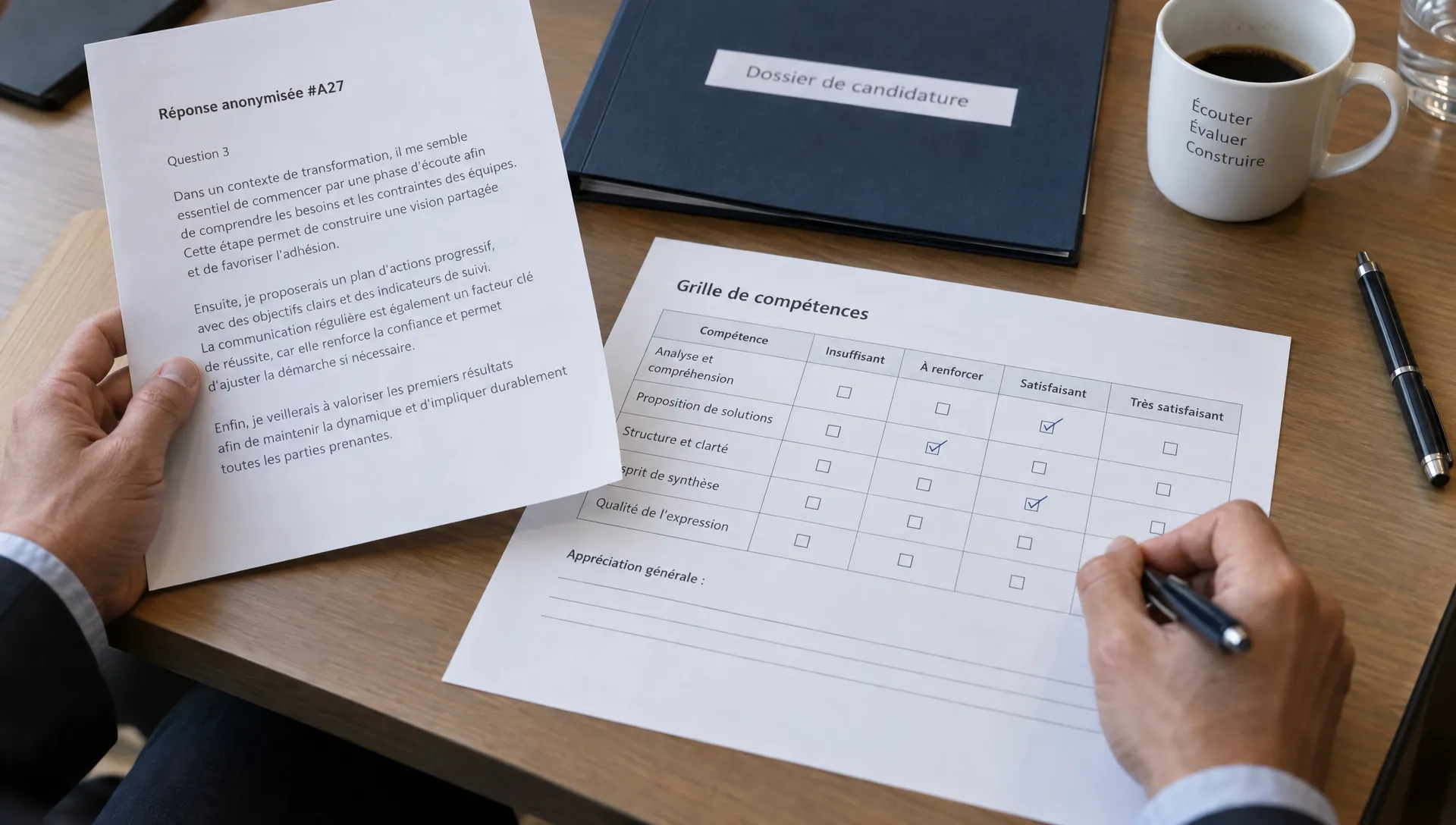
2. Build a concise scorecard with observable criteria
Skills-based hiring becomes practical when each criterion corresponds to expected evidence. Select a few decisive dimensions rather than compiling an inventory of twenty qualities that are difficult to distinguish.
Here is an illustrative example for a customer service adviser role. The weightings should be adapted to the actual work; they are not a universal model.
| Skill assessed | Evidence sought | Illustrative weighting |
|---|---|---|
| Resolve a routine request | Propose a correct solution based on the information available | 40 % |
| Write a clear response | Produce a message that is easy to understand and appropriate for the recipient | 25 % |
| Prioritise requests | Explain the order in which several requests should be handled | 20 % |
| Collaborate and share information | Identify when to ask a colleague for help and what information to provide | 15 % |
For each criterion, describe the levels before meeting candidates. A scale of 1 to 4 can distinguish between an insufficient response, a partial response, one that meets expectations and one that demonstrates exceptional proficiency. Specify what distinguishes these levels in the chosen exercise.
Behavioural skills must also be observable. “Flags an error and suggests a correction” is more precise than “has the right mindset”.
3. Rewrite the job advert and rethink screening
The job advert should reflect the scorecard. Present the responsibilities, the skills expected on arrival and what the company can teach. A degree or length of experience should only be grounds for rejection if the requirement is justified.
Skills-based hiring should also be visible throughout the application process. Explain the stages, the nature of the assessment and the approximate time required. This transparency allows candidates to prepare without having to guess your expectations.
During screening, look for directly relevant evidence: a described achievement, an example of a problem solved or an answer to a job-related question. A different job title is not enough to conclude that a candidate lacks a skill.
Do not automatically request a portfolio or additional work. Some people do not have a portfolio, particularly for confidentiality reasons. Offer another way to demonstrate the same skill, such as a fictional case or a structured conversation.
4. Plan a proportionate work simulation
Choose an exercise that is close to the role but limited to what you actually need to assess. For an administrative role, this could involve processing a fictional file containing several discrepancies. For a support role, it could be a response to a simulated customer request.
In skills-based hiring, the quality of the evidence matters more than the number of tests. A short, well-designed and well-scored exercise can be more useful than several questionnaires with no clear connection to the role’s responsibilities.
Give each candidate the same instructions, the same resources and a comparable amount of time, subject to any necessary accommodations. If the use of a tool or AI is permitted, state this explicitly. Otherwise, you risk comparing work performed under different conditions.
Avoid exercises that produce a deliverable the company can use for free. Use fictional or anonymised data and adapt the difficulty to the level of the role. For a junior position, looking for advanced expertise would amount to recreating an unjustified filter.
5. Conduct a structured interview
The work simulation reveals some of a candidate’s abilities. The interview provides an opportunity to explore decisions made, previous experiences and how the person learns. Prepare a core set of questions, followed by follow-up questions tailored to the answers.
For example, you could ask:
- “Describe a situation where you had to handle several urgent requests. How did you decide on the order?”
- “In this exercise, what information would have helped you make a better decision?”
- “Tell us about a mistake you made at work or during training and what you changed afterwards.”
Skills-based hiring requires you to distinguish communication ability from the skill being assessed. A person who is very comfortable speaking is not necessarily more thorough or effective in the role. Return to the facts: context, personal actions, results and lessons learned.
Also assess the conditions needed for success: support, training or access to certain resources. This helps identify learning potential without confusing it with a skill already acquired.
6. Decide based on the evidence gathered
Each assessor first completes their scorecard individually, before the group discussion. This practice limits the tendency to immediately align with the opinion of the most influential person in the group.
During the debrief, replace “I have a bad feeling” with a specific observation. Which criterion has not been demonstrated? What response or action supports that conclusion? If assessors disagree, return to the evidence rather than a general impression.
A weighted score can help compare applications, but it must not obscure an essential requirement. A missing mandatory authorisation cannot be offset by good communication. Conversely, a gap in a skill that can be learned may lead you to plan training.
Record the decision, including the professional reasons behind it and the areas requiring support after the hire. The scorecard thus becomes an onboarding resource, not just a ranking tool.

Set assessment safeguards and protect candidates
A structured method does not automatically eliminate bias. An exercise may still be unnecessarily difficult, favour certain backgrounds or measure something other than the intended skill. Regularly check its relevance and provide any necessary accommodations to enable a fair assessment.
The French Labour Code, in particular Articles L1221-6 and L1221-8, governs the information requested and the assessment methods used. The information must have a direct and necessary connection to the job or to professional abilities. The methods must be relevant to their purpose, and candidates must be informed of them in advance.
For personal data, limit collection to what is needed for recruitment, define access rights and retention periods, and inform the people concerned. The CNIL recruitment guide provides a practical framework for organising this processing.
Finally, do not turn a personality assessment into an overall judgement of the person. Assess behaviours that are useful in the role, not similarity to the current team.
Measure results, then adjust the method
To find out whether skills-based hiring improves your decisions, track the selection process and what happens after the person joins. The number of applications received is not enough.
Look in particular at the proportion of candidates who complete the assessment, drop-offs at each stage, time to decision and scoring differences between assessors. Frequent disagreements may reveal criteria that are too vague or instructions that are poorly understood.
After the hire, compare the selection results with the skills actually used. Do the strengths observed show up in the work? Were training needs identified? Also gather feedback from the new hire on the relevance of the exercises.
For an initial rollout, you could spend one week analysing the role, another on the scorecard and exercises, then test the process with colleagues before using it. Adjust it based on the initial feedback. When hiring volumes are low, the figures remain unreliable: also examine situations individually.
Use AI without delegating judgement
AI can help draft a job advert, organise applications or prepare for screening. It does not turn imprecise data into reliable evidence: if the initial criteria are poorly defined, automation can reproduce the same flaws on a larger scale.
In skills-based hiring, a matching score should therefore remain an aid to assessment. Check what it measures, the information used and the limits of its interpretation. A low score should not be a reason to skip examining the relevant evidence provided by the candidate.
Before adopting a tool, define the human checks, who is authorised to view the results and how to explain the process to candidates. Also make sure assessors know how to question a recommendation. Technology should support your method, not become an opaque selection criterion.
Frequently asked questions
Should you get rid of the CV? No. It remains useful for understanding a career path and preparing for discussions. The aim is to stop relying on it alone to make the decision. An experience mentioned becomes a point to explore, not automatic proof of proficiency.
Is this approach suitable for small businesses? Yes. A clarified job description, a few observable criteria and a short work simulation may be enough to get started. The process should remain proportionate to the role, the volume of applications and the resources available.
How do you assess someone without professional experience? Skills-based hiring allows you to draw on a work simulation and relevant experiences from training, volunteering or personal life. Distinguish skills already demonstrated from the ability to learn, then specify the support you can offer.
How can you assess mindset without hiring identical profiles? Translate your expectations into professional behaviours: asking for help, keeping a commitment or receiving feedback. Rule out criteria based on social similarity, shared hobbies or personal affinity, which do not demonstrate the ability to perform the role.
Move from a method to a shared process
Start with one role, one scorecard and clearly defined evidence. Validate their relevance before expanding the approach.
To support this process, Koann offers skills and personality profiles, intelligent screening, matching scores, and interview and feedback tracking. These features can support a shared method while leaving recruiters responsible for examining the evidence and making decisions.