


How to Evaluate a Job Offer Before Accepting It
Before accepting a job offer, check what you will actually do, under what conditions and with what resources. An impressive job title or a salary increase does not always make up for a poorly defined workload, a management style that does not match your expectations or commitments made only verbally.
The aim is not to obtain every possible guarantee. It is to distinguish established facts, negotiable points and uncertainties you are willing to accept. Here is a method for making your decision based on concrete information rather than the impression left by your last interview.
Identify the document you have been offered
A job advertisement, an offer received by email and an employment contract do not serve the same purpose. The advertisement describes a recruitment need. Subsequent documents may specify the terms of employment and, depending on their content, have legal consequences.
Under French law, an offer of an employment contract and a unilateral promise of employment are two distinct concepts. Their effect depends on their wording, the details specified and the conditions for responding. The Service Public guide to these commitments explains the difference.
Do not assume that an email has no consequences simply because no contract has been signed yet. Before replying “agreed”, check the document you have received, its validity period and any conditions that must be met. If anything is unclear or you are considering resigning, have your situation clarified before committing.
Evaluate a job offer based on your priorities
Start with your own criteria before rereading the recruiter’s selling points. Without this step, attractive pay can overshadow a constraint that is crucial to your daily life.
Distinguish three categories: essential conditions, negotiable preferences and additional perks. A minimum fixed salary, a workplace compatible with your personal life or predictable hours may belong in the first category. The exact job title or certain benefits may fall into the other categories.
Limit your deal-breakers to a few genuinely essential points. For each one, set a measurable threshold: “two agreed remote working days” is more useful than “good flexibility”.
Also picture yourself in an ordinary week. How long will commuting take? What hours will you need to work? This check is particularly useful if the role involves travel between Lyon and La Réunion, a move or regular communication across time zones.
Check the duties, resources and expected results
A job offer deserves scrutiny beyond its list of responsibilities. Terms such as “lead”, “support” or “develop” remain vague until the scope and resources are specified.
Ask what you will be expected to accomplish during the first three months and by the end of the first year. Ask for priorities to be clarified if several duties appear to compete. Someone hired to develop an activity will have less time to do so if they also have to take on a significant administrative workload.
Three questions can help you get useful answers: “How will you know I have made a successful start?”, “What resources will be available?” and “What decisions can I make without approval?”
Looking at the skills actually used also helps distinguish essential existing skills from those that can be learned. If you lack a skill, check what support is planned rather than assuming training will be arranged.
Finally, ask why the position is open. A newly created role may require you to establish your own methods. A replacement, on the other hand, calls for an understanding of what will stay the same, what will change and how the handover will be handled.
Compare compensation without confusing potential with guaranteed pay
To compare a job offer with your current situation, start with the guaranteed gross annual base salary, then examine variable pay and benefits separately. A quoted total may combine elements with very different conditions for earning them.
For example, €38,000 gross in base salary and €6,000 in variable pay do not offer the same security as a base salary of €42,000, even if the theoretical total is higher. For variable pay, ask about the targets, calculation method, payment frequency and conditions applicable in your first year. The team’s actual attainment level can inform the discussion, without guaranteeing your future results.
Also check whether the annual amount includes a possible thirteenth-month payment. A stated bonus should not be counted twice in your comparison.
Then factor in benefits and new expenses: transport, meals, housing, childcare or business travel costs you may have to cover yourself. Distinguish expense reimbursements from genuine additional compensation.
Finally, ask how salary reviews are decided. An annual review does not mean a guaranteed pay rise. A promise of an increase “after a few months” remains uncertain without a clearly defined amount, timeline and conditions.
Review working conditions and sensitive clauses
The contents of a job offer should be consistent with the draft contract and the agreements made during interviews. If a decisive point comes up only in conversation, ask for written confirmation and, where appropriate, for it to be included in the relevant document.
First, examine the type of contract, start date, workplace, working hours and probationary period. For a fixed-term contract, check in particular the reason for its use and its end date or the planned conditions for ending it. Also identify the applicable collective agreement and the proposed classification.
Remote work deserves a close look: how many days are provided, from which locations and under what conditions can the arrangement change? Similarly, “flexible hours” does not necessarily mean complete freedom over your schedule. Ask for details of required attendance hours, travel and any on-call duties.
Pay particular attention to mobility, exclusivity or non-compete clauses where they exist. Their scope and validity depend on several conditions. If a clause could restrict your future activity or require substantial relocation or travel, have it reviewed by a legal professional before signing.
Compare what you are told with the team’s reality
A good relationship with the recruiter does not tell you everything about your future day-to-day work. Where possible, speak with your direct manager and a team member. The aim is not to gather perfect testimonials, but to understand everyday practices.
Ask for a recent example of a disagreement, a change in priorities or an excessive workload. How was the situation resolved? Who decides when a deadline becomes unrealistic? Concrete answers are more informative than phrases such as “supportive team” or “high level of autonomy”.
Consistency between the employer brand and the reality of recruitment is another clue. Different terms presented by different people call for clarification, not necessarily an immediate refusal.
In education, also examine the educational approach. Colegio Pioneros in Chicureo, for example, presents a bilingual and personalised approach. For a candidate considering joining a school that states these aims, the useful question is how they translate into the work: lesson preparation, coordination, resources and support for pupils.
Finally, look for professional compatibility rather than personal similarity with the team. Sharing working methods does not require having the same backgrounds or interests.
Clarify and negotiate outstanding points
An incomplete job offer is not automatically a bad one. The decisive signal is often how the employer responds to your requests: with precision, consistency and a willingness to clarify, or with repeated avoidance.
Bring your questions together in a single conversation and rank them by priority. Start with the points that determine your decision, then address your preferences. This will help you avoid a succession of requests that makes the discussion difficult to follow.
When negotiating, connect your request to the scope of the role and your expected contribution. Salary is not the only lever: the start date, certain work resources or working arrangements may also matter. However, do not treat an uncertain benefit as equivalent to a firm commitment.
You could word your response as follows:
Thank you for this offer. The scope of the role and my conversations with the team have confirmed my interest. Before making a decision, I would like to clarify the targets for variable pay, the remote working arrangements and the terms of the probationary period. Could we also discuss an annual base salary of €X, given the responsibilities presented?
After the conversation, ask for an updated version of the agreed terms. If the response deadline does not allow time for these checks, request a specific extension rather than accepting in a hurry.
Decide using a simple scorecard, without hiding uncertainties
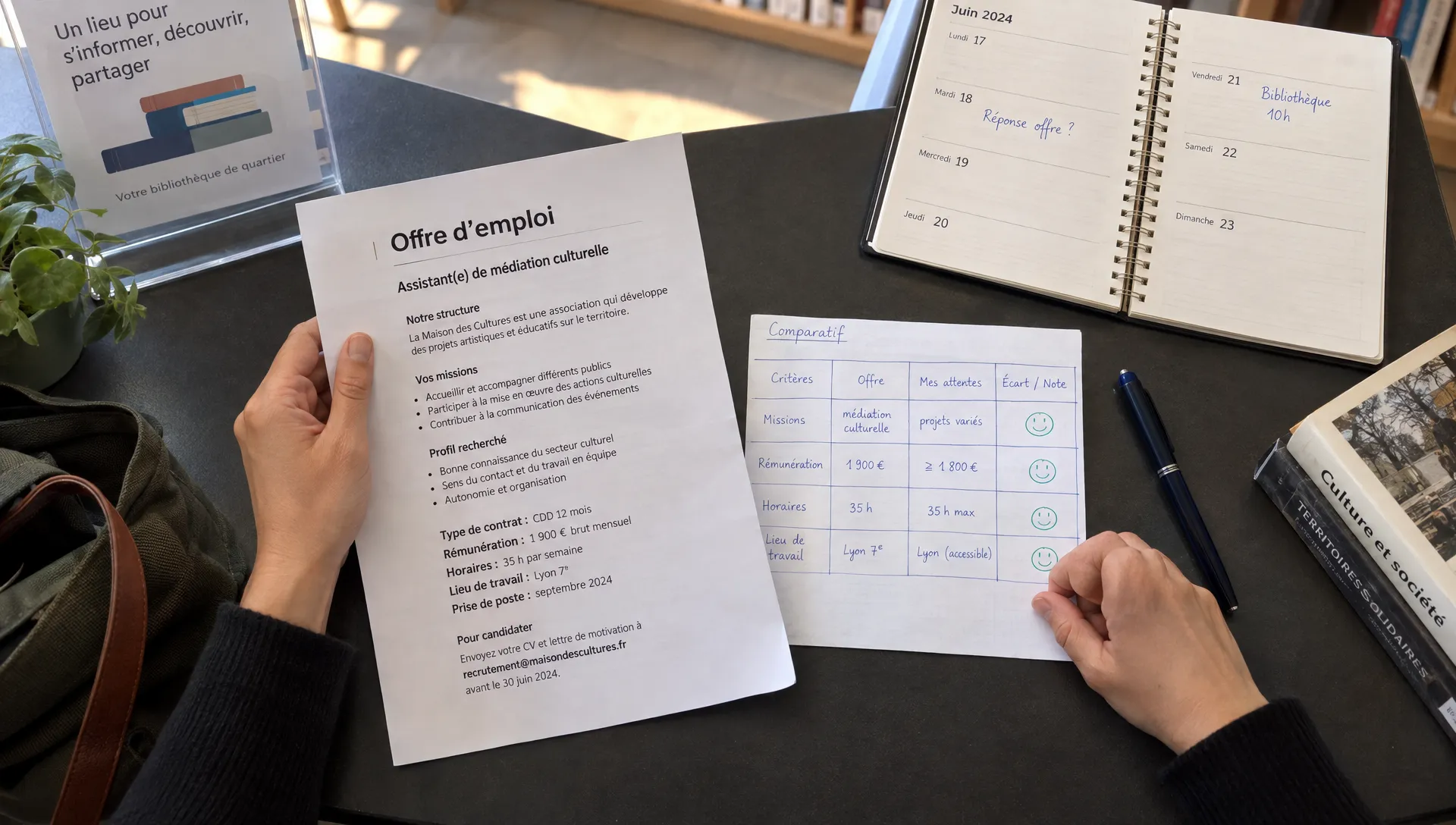
To choose between several options, assess each job offer against the same criteria. A short scorecard is enough, provided you record verified information and not just your level of enthusiasm.
| Criterion | What to check | Status to record |
|---|---|---|
| Duties | Priorities, scope and available resources | Confirmed, needs clarification or incompatible |
| Compensation | Base salary, variable pay and payment conditions | Confirmed, needs clarification or incompatible |
| Working arrangements | Hours, location, remote work and travel | Confirmed, needs clarification or incompatible |
| Management | Autonomy, feedback and workload decisions | Confirmed, needs clarification or incompatible |
| Contractual terms | Contract, probationary period and specific clauses | Confirmed, needs clarification or incompatible |
A deal-breaker should not disappear into a good average score. If weekly travel is impossible for you, an excellent salary does not solve that problem.
Then distinguish an acceptable uncertainty from an uncontrolled risk. Not yet knowing all your future colleagues is common. Not knowing which site you will work at when a move is necessary calls for an answer before you accept.
Your decision can then take three forms: accept the confirmed terms, negotiate a few specific points or decline while briefly explaining the main incompatibility.
Frequently asked questions before committing
Can I ask for time to think? Yes, you can ask for time to review a job offer. Propose a response date and check that the employer agrees to it, particularly if the offer already has a deadline. Use this time to clarify the terms, not just to wait for another opportunity.
What if the written terms differ from what was discussed in the interview? Point out the discrepancy precisely and ask for a correction or an explanation before committing. A difference may result from an error, but a reassuring verbal response does not resolve an ongoing contradiction in the documents.
Should I accept a role without mastering all the required skills? You do not necessarily have to decline. Distinguish skills that are essential from day one from those that can be acquired. Above all, check the expectations for your initial period, the time available for learning and the support actually planned.
Can I withdraw my acceptance? That depends on the nature and content of the commitment and when you withdraw. Do not assume that the absence of a signed contract always leaves you free of any commitment. Seek appropriate legal advice if necessary.
Look for a lasting fit with your career goals
A compelling job offer brings together duties you understand, acceptable conditions and commitments clear enough to make a decision. Keep your scorecard: it will also help you compare future opportunities.
With its matching approach based on skills and mindset, Koann connects profiles with career opportunities. Discover this approach to guide your search, then assess each offer against the criteria that really matter to you.