

Simplify the Application Process to Reduce Drop-Offs
An overly long application process can discourage a candidate before you have even discovered their skills. A mandatory account, information entered twice or an attachment that cannot be uploaded from a phone: these obstacles add effort without necessarily improving selection.
The goal is not to remove every requirement, but to ask for each piece of information at the right time. To reduce drop-offs, start by identifying obstacles, simplify the first contact, then check that the applications you receive remain relevant.
Identify where candidates leave the process
A visit to a job posting without an application does not necessarily mean someone abandoned the form. The person may simply be learning about the role or deciding that the conditions do not suit them. So distinguish between viewing the posting, starting the form and actually submitting it.
To measure drop-offs after candidates start, use this formula:
Drop-off rate = (applications started but not submitted ÷ applications started) × 100.
Hypothetical example: out of 100 applications started, 64 are submitted. The drop-off rate is 36%. This figure is not an industry benchmark, but a starting point for tracking your own improvements.
Choose an observation period that gives candidates time to return and complete their application. Also avoid counting the same application more than once when your measurement system allows you to deduplicate it in compliance with applicable rules.
Simplify the application process from the first contact
For each field, ask a simple question: is this answer necessary to decide whether to have an initial conversation? If it is only needed to prepare for hiring or complete an administrative file, collect it later.
An initial form can focus on relevant contact details, a few elements directly related to the role and a way for candidates to present their skills. The right level of detail depends on the job: a licence essential to the role is not the same as a preference for how a CV is presented.
| Information requested | At first contact | Save for later |
|---|---|---|
| Name and contact details | Yes, so you can respond | Full administrative details |
| Essential skill or certification | A targeted question if it is a requirement for the role | Supporting documentation if verification is not yet necessary |
| Professional background | CV, profile or presentation suited to the hiring process | Exhaustive re-entry across multiple sections |
| Motivation | A short answer if it genuinely helps with screening | A lengthy letter requested by default |
| Hiring documents | Generally unnecessary at this stage | Collect at the appropriate time |
This approach is consistent with the data minimisation principle set out in Article 5 of the GDPR, as presented by the CNIL: data must be adequate, relevant and limited to what is necessary.
Also make optional fields easy to identify. A form feels less demanding when candidates immediately understand what is required and why.
Test the process on a phone, all the way through submission
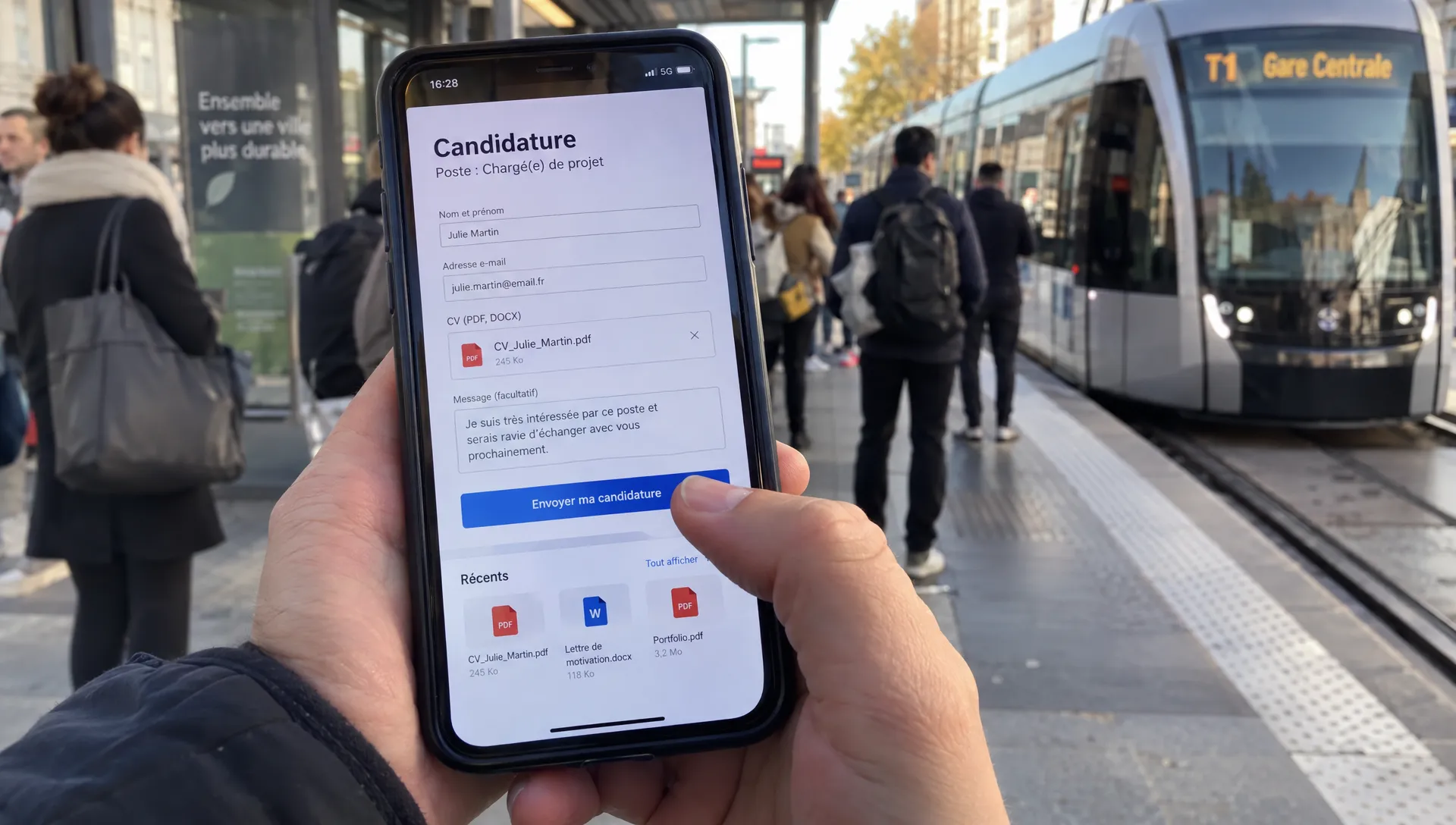
An application process designed on a computer can become frustrating on mobile. Do not just check that the page displays: complete an entire application on a phone, under the same constraints as someone discovering the job posting while on the move.
In particular, test uploading a CV, returning to the previous step and correcting an error. If the form clears after an incorrect file format is submitted, candidates have to repeat work they have already done. This friction is worth fixing before an aesthetic detail.
Avoid requiring account creation before any contact when your tool allows another approach. If an account is necessary, explain its purpose and limit the steps needed to create it. Saving or resuming an application can also be useful, provided the solution you use actually offers that option.
Accessibility matters just as much: clear labels, keyboard navigation, understandable error messages and correctly identified fields. A warning should explain what needs correcting without erasing answers already entered.
Finally, preserve the context of the job posting. Someone who arrived at a specific role should not have to search for it again in a long list.
Save substantial effort for the stages where it is useful
A detailed letter, a personality questionnaire and a case study can represent a lot of work before the first conversation. Together, they can turn the application process into an endurance test rather than an assessment of skills.
Link every request to a concrete decision. A short question may be enough to check essential availability. A more in-depth practical exercise can wait until an initial conversation has confirmed mutual interest.
For an exercise, state the objective, estimated duration and evaluation criteria. Prefer a fictional scenario or a representative sample of the work over a deliverable the company could use directly. Also test the exercise internally: instructions their creator considers “quick” may take much longer for someone unfamiliar with the context.
Requirements should remain appropriate to the role. Asking for a portfolio may be relevant for some creative positions, without making it a general rule for every job.
Simplifying does not mean selecting less rigorously. It means replacing routine requests with useful evidence, gathered when it can genuinely inform the decision.
Provide clarity before and after submission
Uncertainty can also cause a candidate to stop their application. Before starting, they should be able to understand what to expect: required documents, planned stages and any exercise. If you give a duration, verify it against the actual process rather than choosing an attractive estimate.
A clear application process therefore starts with the job posting. The workplace, working hours and essential conditions should be available before someone invests their time. The mistakes that make a job posting unattractive can create difficulties that a better form alone will not resolve.
After submission, confirm that the application has been received and explain the next step. A useful message identifies the role, how the candidate will be contacted and a response timeframe the team can realistically meet.
If the schedule changes, inform the people still involved. For interviews, provide clear appointment arrangements and a simple way to report unavailability. A cancellation communicated in advance should not be confused with disappearing without a response.

Check that simplification also improves quality
A better submission rate alone is not enough to prove that recruitment is working better. Removing an essential question may increase the number of applications received while shifting the verification work to recruiters.
To evaluate the application process, track the completion rate, the proportion of applications meeting essential criteria and the time spent processing them together. Also monitor later withdrawals: a very short process can conceal poorly understood conditions that candidates only discover during the interview.
| Metric | What it helps you observe |
|---|---|
| Applications submitted as a proportion of applications started | How easy the form is to complete |
| Applications meeting essential criteria | How useful the information collected is |
| Processing time per application | The workload shifted to or avoided by the recruiter |
| Withdrawals before the first interview | Difficulties that persist after submission |
Change one thing at a time where possible: remove a field, move a document request to another stage or clarify an instruction. Compare sufficiently similar periods and roles, taking changes in distribution channels into account.
Supplement the figures with a few user tests. Watching someone try to attach their CV can explain an obstacle that statistics alone cannot reveal. Do not record unnecessary personal data when conducting these tests.
Automate repetitive tasks, not the entire relationship
Automation is useful when it prevents data from being re-entered, makes follow-up easier or helps organise responses. It becomes counterproductive if it adds a generic questionnaire unrelated to the needs of the role.
Before adding a stage to the application process, check that equivalent information is not already available. Submitting a CV should not automatically lead to candidates having to re-enter all the same experience. Similarly, a matching score should support analysis, not replace every opportunity for clarification.
The team must retain control over the criteria used and be able to review atypical situations. To explore this balance further, Koann explains how to make candidate screening more reliable with AI while maintaining human oversight.
Finally, assign someone responsibility for each handoff. An application can be submitted without difficulty and then get stuck between the recruiter and the manager. A smooth candidate experience also depends on an internal organisation capable of taking the next steps.
Frequently asked questions
Should a CV be mandatory? Not always. It depends on the information needed for screening and the other ways candidates can present their skills. Above all, avoid requesting a CV and then requiring candidates to re-enter all its contents.
How many stages should an application process have? There is no universal number. Each stage should serve a distinct decision. Combine redundant requests and clearly communicate necessary assessments, without hiding complexity behind an apparently short form.
How can you distinguish a drop-off from a rejected application? Here, a drop-off is an application that was started but not submitted during the observation period. A rejection occurs after receipt and evaluation. These events should remain separate in your metrics.
Can you follow up on an incomplete application? A follow-up requires an appropriate framework for using contact details. Explain this use and check that it complies with applicable rules before setting up automated messages.
Better organise the process with Koann
Start by testing your current form, removing an unnecessary request and clarifying the next step. These changes provide a measurable baseline before adding new tools.
To organise the next steps, Koann combines skills and personality profiles, matching scores, recruitment management and interview tracking. The goal remains to collect useful information, then enable recruiters to use it without multiplying requests to candidates.